Sunday, April 6, 2014

Personal Philosophy

The journey to the philosophy I have constructed started with a small panic and a spark of curiosity. Last summer’s end, I had the privilege of meeting several people who seemed to know themselves and how to live their life in accordance to that understanding. This scared me, seeing these people who seemed so in touch with themselves made me question my ethics, values, and beliefs. That summer I made it a goal of mine to use the school year to learn more about myself and my beliefs and how I should live my life. I, not subscribing to any religious belief in particular, researched different religions over the summer to see what beliefs I could hand pick and make into my own. Therefore, most of my values can be traced to some religion or a movement. From what I have gathered and learned so far, the values that I now adhere by are an amalgam of optimistic and compassionate thought.
A major tenant of mine is best summarized by the quote, “animals are here with us, not for us.” I realized the temporariness of life on this planet and, much to my mother’s chagrin, decided to become a vegetarian. Inspired mostly by the Buddhist doctrine that advocates the kind treatment of animals, I developed a deeper and wider appreciation for life. I figured that the life of an animal should be valued just as much as a life of a human, both of us are alive on this planet for a short amount of time and deserve that time to be cherished. Sometimes an individual forgets that people other than themselves feel pain as they do, but most understand that all humans are capable of feeling pain. Lacking verbal expression to articulate pain, animals are often thought to not feel pain; however research has proven that animals certainly do feel pain. So I take that understanding of pain in other humans and extend that to animals. When researching the meat industry I was appalled at the treatment and conditions the animals were subject to, thus reinforcing my beliefs and reasons to become a vegetarian. I am convinced that living things deserve to be treated delicately and compassionately, not as a means of profit. This belief is noticeably influenced by the fact that I do not believe in an afterlife. This being so I regard life as something extraordinary and to end it would be the ultimate tragedy because it would mean the final end. 
I regard humans in the same basic format. I believe we must care for each other without restrictions. Often times I feel like we are told to only care about those who enter our closest ties, family or friends. Borders, race, gender, and beliefs should not limit our love for other people. Humans are deserving of compassion equally, across the globe, not matter what. We are all equal, in the sense that we are all entitled to living equally happy and secure lives. People shouldn’t have to struggle for survival when supplies are ample enough to keep them secure.

            Another set of principles I have adopted are those of Non-violence. When studying the civil rights movement what I found most appealing was the courageousness of the civil rights activists, who without violence were able to achieve their goals.  Through more observations in history I found that violence seldom achieves the goals it sets out for. I concluded that words are better persuaders than weapons. Beyond simply denying violence, non-violence seeks to win friendship and understanding. I decided that I would refuse to accept anyone as an enemy. When I did this I vacuumed up hate and replaced it with love and compassion, giving me a sort of emotional peace once accepted. But poverty persists along with other tragedies and violations of human rights. And it is easy to get angry the people who allow this to happen or perpetrate these actions. We default on looking at those people with hate and anger, coming short of any attempts of understanding. I do not believe people are to blame, if anything they are victims of a society that has raised them to act that way. If we look at others with the same understanding lens, it is possible to help people become better people.

Tuesday, March 18, 2014

Macrocosm Versus Microcosm Chapters 16-19 Assignment G

          Chapter 16 of  The Grapes of Wrath, focuses on the small world of the Joads, whereas in chapter 17 a larger focus of all the migrants is taken. Both in the microcosm of the Joads and the macrocosm of travelers, people who are not family, join together in a symbolic family. Family becomes redefined as those who are struggling with you, not just blood relative. In chapter 16, when Casy, Al, and Tom are out getting a car part Ma makes dinner for all three of the men. Casy is not a part of the family but is still fed as if he is one, he is some what surprised  by Ma's gesture and remarks "she don't forget nobody." This goes the same in the macrocosm, in chapter 17 strangers become family, multiple families are able to become one "unit." Another similarity that presents itself in these two chapters is the concept of the past, particularly the taboo that it is. 
           When Tom Joad is questioned about his time in jail he becomes very uncomfortable and tells Al he'd "ruther jus' lay one foot down in front a the other" (176). One of the first few rules mentioned in chapter 17 asserts the right to keep the "past black hidden in the heart" just as Tom did. In this similarity it is shown that migrants are to stay hopeful for the future and understand that their past is long behind them and will remain in their old towns, where they migrated from. Distancing themselves from the past helps migrants create a new identity in their new environment. 
            In chapter 16 when Tom eyes a kettle cooking beans, the woman generously offers to give Tom a bowl of beans after they finish cooking. This connects with the general view of camper society, presented in chapter 17 which states that one should share their food with those who are hungry. Both chapters capture the idea that helping others who are less fortunate than you should be a value everyone lives by. Further, the actions of the women who offers Tom the beans and the rules of the camping society connects directly to the transcendental belief that insists helping others is the same as helping yourself, because good deeds are reciprocated overtime.

           The microcosm of the Joads helps readers make a more emotional connection with the macrocosm. When observing people on a large scale it can be hard to really connect with the individual when individuals are represented in numbers. So exposing readers to the Joads allows for the extension of their empathy to the migrant community as a whole. Therefore the micro and macro lenses help to establish a deeper emotional connection to a wide range of people who are now able to be seen as individuals.

Monday, March 17, 2014

Rules Chapters 16-19 Assignment A


Rules for Travelers

 1.No fouling near camp site.
  2.Keep drinking water clean.
    3.Eat rich food in private unless you offer to share with hungry
    4.Relationships are permitted if and only if the man commits long term and agrees to protect child.
   5.The privacy of a tent must be valued.
   6.What is in the past stays in the past.
   7. Absolutely no seduction, rape, murder, theft, or adultery.
   8.The right to refuse, accept, offer, decline help.
   9. Stay quiet when camp is sleeping.
   10.Feed the hungry.
       
                       One of the rules discussed in chapter 17 asserts that if someone is hungry in the camp and you have the ability to feed them you must do so. A further explanation in the chapter emphasizes that by feeding someone who is hungry you insure that if you ever are in that unfortunate position someone will provide for you. In practice this rule attempts to broaden the wellbeing of the community by expanding the responsibility to the whole community. This rule also functions as an equalizer. It reminds campers that just because someone has less than you does not mean they are less than you. When a camper shares his food with a hungry camper it should not be interpreted as one giving to the needy and the other receiving from the fortunate, but one doing his or her civic responsibility to one another. This rule runs on the idea that there will always be someone able to help another person. If everyone was starving in the camp the system would collapse. So this rule places tremendous hope in the migrants and their ability to find jobs

               Another rule discussed in chapter 17 prohibits short term love affairs. Instead the rules assert that romantic relationships have to be a long term commitment between the two partners. When thinking about the struggles each family goes through with this journey it becomes clear that bonds and relationships are integral for survival. In that case, to have a onetime affair, especially one that is so intimate, would make it emotionally difficult to stay aloof. The camper society relies so much on the relationships they form that having a non-committed relationship could be detrimental to the psyche of the two people involved. Another function of this rule is to prevent drama that could arise with a short tryst. This function focuses more on keeping peace within the community rather than people’s personal lives. Less gossip, means more is able to be done and the easier it is for people to work together. The book mentions these relationships are dangerous to the world of the campers, overall having a mix of commitment and non-commitment would not work in this society, it would cause more problems than the society could handle.  

Saturday, March 15, 2014

Quote Response Chapters 11-15 - Assignment D *

"But how can such courage be, and such faith in their own species? Very few things would teach such faith. The people in flight from the terror behind- strange things happen to them, some bitterly cruel and some so beautiful that the faith is refired forever." (122)


This quote in particular made me reflect on the principles I live by and also filled me up with a feeling of hope. One of the most appealing set of principles I have learned is the principles of nonviolence, many of which are present in this quote. The first principle states that nonviolence is a way of living for courageous people, like the first line of the quote, this principle acknowledges the difficulty in acting in a manner that is loving and unconditionally accepting. It deeply bothers me that we have still not overcome our competitive nature and continue to accept the us versus them mentality. Yes, it is difficult to overcome that carnal instinct, but in no way is it impossible. I think that may have been what struck me, the capacity we as a species have to love but our inability to express it to everyone in our species. I believe this faith can be taught but is failed to be. So many examples are present in history of people working together to destroy injustice, not people, understanding and loving each other and their enemies. If more emphasis was spent learning about events like the Indian independence movement or the civil rights movement rather than on wars maybe more people would have more faith in their species. We focus too much on the "bitterly cruel" parts, which I believe makes it easier to think of others as being the ones to blame and reinforces the us versus them mentality. But how we see other humans is not just taught to us through history but it also experienced, first hand. The quote continues and says that kind, beautiful actions can help ensure this faith in others, or simply that kindness provokes kindness. And I know this to be true, some kind actions have had the power to  helped people live another day. I believe in that because I know one of those people who survived off of the kindness and compassion of others. It is not easy to have this faith, but after reading this quote I'd rather struggle trying to love than to easily accept hate.

Wednesday, March 12, 2014

Highway 66- Chapters 11-15 Assignment B


The number of families who owned cars saw a significant increase during the 1920's, prompting the creation of a new high way that would stretch across the United States, linking the country by concrete rather than the traditional train tracks. This revolutionized vacations, allowing people to drive out of town and get away from home life. Highway 66 is 2,451 miles long, spanning from Chicago, Illinois to Los Angeles,California. Established in 1926 the vast highway began to adopt several names such as the "Main Street of America" and "The Mother Road," showing just how revolutionary it was as a highway. Route 66 never saw more travelers than it did in the 1930's. Oklahoman farmers flooded the road to travel west towards California in attempts of the Dust Bowl that plagued the Mid West. The masses of travelers  prompted small mom-and-pop businesses to sprout up along Route 66. Small Cafes and Restaurants catered especially to the trucks drivers who often used the road to transport goods. Besides opportunity for businessmen, the road symbolized opportunity to those traveling on it. Sojourners from all over, saw Highway 66 as the single object that could deliver them from their suffering, it was the start of a brighter future.


Sources: Time Official Site Picture1 Picture 2 Picture 3

Friday, March 7, 2014

Man Versus Self - Chapters 1-10 Assignment G

Jim Casy vs. Self

" 'No, I don't know nobody name' Jesus. I know a bunch of stories, but I only love people. An' sometimes I love 'em  fit to bust, an' I want to make 'em happy, so I been preachin' somepin I thought would make 'em happy' (23). "

Jim Casy, a former preacher, reflects on his reasons for leaving the church. He felt guilty for having affairs with the women of his congregation and looks within himself to find out if what he was doing was morally wrong. Casy realizes that he loves people unconditionally and preached only to make them happy, not to communicate religious ideology. This then challenges his long held belief system. In the novel values are constantly being challenged by outside forces, like the oppressive banks. However, Casy's self-reflection is more induced by his own self-interest, showing his deep rooted inner conflict.

Muley Graves vs. Self


"Somepin went an' happened to me when they tol' me I had to get off the place. Fust I was gonna go in an 'kill a whole flock a people. Then all my folks all went away out west. An' I got wanderin' aroun' (...) I'd tell myself, 'I'm lookin' after things so when all the folks come back it'll be all right.' But I knowed that wan't true. There ain't nothin' to look after. The folks ain't never comin' back. I'm jus' wanderin' aroun' like a damn ol' graveyard ghos' " (51)


Muley Graves is the last member of his family to stay in Oklahoma and ride out the Dust Bowl.When he is forced of his land Muley is filled with hostility towards people. He blames the bankers for his condition and can think of no other way to rid of his anger. In this situation Muley must overcome his inner barbaric inclinations and deal with the absence of his family. He denies the permanence of his family's absence, to justify his reasons for staying in Oklahoma. Muley tries to tell himself that his decision to stay in Oklahoma was honorable in that he was taking the role of a care taker to the land, but he cannot truly believe his words. Muley struggles to accept things that he knows are true which leaves him making decisions that end up hurting him more than helping him. His denial causes a constant inner conflict within him between what he thinks is right and what he knows is practical. 

Biblical Connections Chapters 1-10 Assignment I *

The Title

Observable biblical and religious connections in book The Grapes of Wrath, begins with the title. The phrase "grapes of wrath" appears in  Book of Revelations (14:19-20), which reads:

So the angel swung his sickle to the earth and gathered the clusters from the vine of the earth, and threw them into the great wine press of the wrath of God.

This quote embodies the anger of the farmers towards the repressive institutions that have brought them to their plight.


The Book Of Exodus and Moses

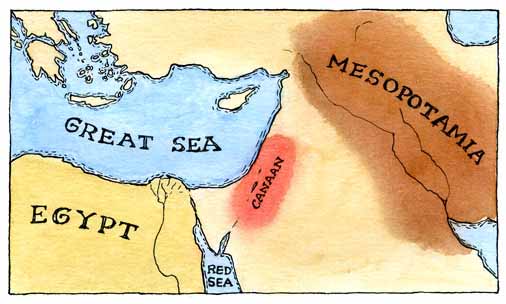
The Okies exodus to California parallels the Israelite exodus out of Egypt. The appropriately named, Book of Exodus, chronicles a man named Moses who leads the enslaved Israelites to the promised land of Canaan. Before being called to lead the Isrealites, Moses killed an Egyptain who was abusing an Isrealite which draws a connection to the character of Tom Joad, who in chapter four, revealed that he killed a drunken man who stabbed him. Both Moses and Tom actions were provoked by a violent perpetrator. 

Tom's reconciliation with his family after he is released from jail and the subsequent decision to travel west to California, is like Moses becoming the leader of the Isrealites and deciding to travel west to Canaan. Like the Isrelaites the Joads seek to end their oppression by travelling to a promised land. Both travelling west face doubt among their group. The Isrealites and the Joads both fear of the troubles they will face on their journey.


The Book Of Job

This biblical story first draws connection to the Grapes of Wrath in the title. Job is pronounced Jobe, which sounds strikingly similar to the surname Joad. The hard times faced by the Joads allude to the suffering of Job, who faces several challenges to prove his commitment to God. Both suffer from a natural catastrophe that challenge their ability to survive. Job refuses to let these problems get the best of him and reaffirms his commitment to God, like the Joads who continue to put their faith in California, despite what rumors they hear.


The Book of Genesis


Steinbeck uses biblical diction to allude to the writing style of the bible.

Rose of Sharon

Rose of Sharon is a young women mentioned in the book of Songs who is seen as a symbol for hope and the only chance for new life for the people. Rose of Sharon in The Grapes of Wrath can be seen as owning this same symbol by virtue of her pregnancy. She carries a new generation that can be raised in the West with better chances of living a good life.


Sources: Title Info Allusions to Bible Mrs.Schuet Spoilers, Class Worksheet